- 12th March, 2026
- By Rob Lawson
How AI Digital Marketing Actually Works: A Reality Check for 2026
AI digital marketing isn't a futuristic concept anymore; 88 per cent of marketers already use it. The technology has moved beyond buzzword status and is now integrated into every aspect of marketing work, from audience targeting to campaign optimisation. Indeed, 80 per cent of marketers believe more than a quarter of their tasks will be intelligently automated in the next five years. It offers numerous applications, from AI-powered social media scheduling to supporting search engine optimisation (SEO) services and many other marketing activities.
We've cut through the hype to show you how AI for digital marketing actually functions in 2026. This guide walks you through the current state of marketing AI, how these tools work behind the scenes, and which AI in marketing applications deliver measurable results you can count on.
The Current State of AI in Digital Marketing: What's Real vs What's Hype
Most marketing teams claim they're using AI, yet the execution tells a different story. Only 6 per cent of marketers have fully implemented AI in their workflows, even though 80 per cent feel urgent pressure to adopt it. This gap reveals something critical about the current state of AI digital marketing: intention vastly outpaces actual capability.
The readiness problem runs deeper than most admit. While 72 per cent of marketers plan to use more AI in the next year, particularly for tasks like content creation services, only 45 per cent feel confident in their ability to use it successfully. Conversely, 62 per cent of employees believe AI is overhyped. The scepticism stems from real obstacles: 52 per cent of marketers lack control over their own data strategy, and 37 per cent cite poor system integration.
Where AI for digital marketing does work, results are measurable. Companies using AI in marketing improve performance by up to 30 per cent in lead generation and customer engagement. Campaign optimisation through automated bidding delivers 30 per cent lower customer acquisition costs, while predictive analytics helps identify churn risks before they materialise. 
The harsh truth? Over 70 per cent of digital transformation initiatives fail due to poor alignment and unclear objectives, not because the technology lacks capability. Most businesses layer marketing AI on top of messy data, bloated tech stacks, and weak attribution models. AI becomes an experiment rather than a revenue engine, explaining why only 1 per cent of businesses believe their AI investments have reached maturity.
How AI Digital Marketing Tools Actually Function Behind the Scenes
The mechanics behind AI digital marketing tools follow a structured pipeline: data collection, pattern recognition, prediction, and automated execution. These systems pull customer information from CRMs, websites, email platforms, and social channels, then process it through machine learning algorithms that identify trends humans would miss.
Pattern recognition forms the foundation. AI analyses behavioural signals, engagement history, and conversion data to spot regularities and correlations across massive datasets. Subsequently, predictive models use these patterns to forecast future customer actions, such as churn risk or purchase likelihood. 
Two distinct AI types power different functions. Predictive AI examines historical data to anticipate outcomes, while generative AI creates new content based on learned patterns. Both rely on machine learning algorithms that improve performance as they process more information, refining predictions without manual programming.
Execution happens through continuous feedback loops. AI systems monitor campaign performance in real time, detect anomalies instantly, and adjust targeting or messaging automatically. For instance, algorithms shift ad budgets toward winning variations while reducing spend on underperforming segments.
Data quality determines everything. AI tools trained on biased, outdated, or incomplete data produce flawed insights regardless of algorithmic sophistication. Equally critical, human oversight remains essential. Without clear direction and accountability, AI agents may misinterpret data and take actions misaligned with business goals.
Marketing AI Applications That Deliver Measurable Results in 2026
Three specific AI impacts on digital marketing applications that stand out for measurable performance in 2026.
Dynamic Creative Optimisation (DCO) automates ad creation by assembling personalised variations from component libraries, testing combinations in real time, and scaling winners automatically. One healthcare brand saved AUD 420,472 in production costs while increasing website traffic by 55 per cent using DCO tools. Campaigns using automated creative optimisation achieve up to 58 per cent increases in ROAS and 30 per cent reductions in CPA.
Budget optimisation through AI delivers equally concrete results. These systems analyse performance across channels and reallocate spending automatically based on marginal returns. A fashion retailer saw a 47 per cent ROAS increase when AI detected trending products and shifted budgets from underperforming categories within hours. The technology processes conversion rates, acquisition costs, and inventory levels to make micro-adjustments every six hours rather than relying on weekly manual reviews.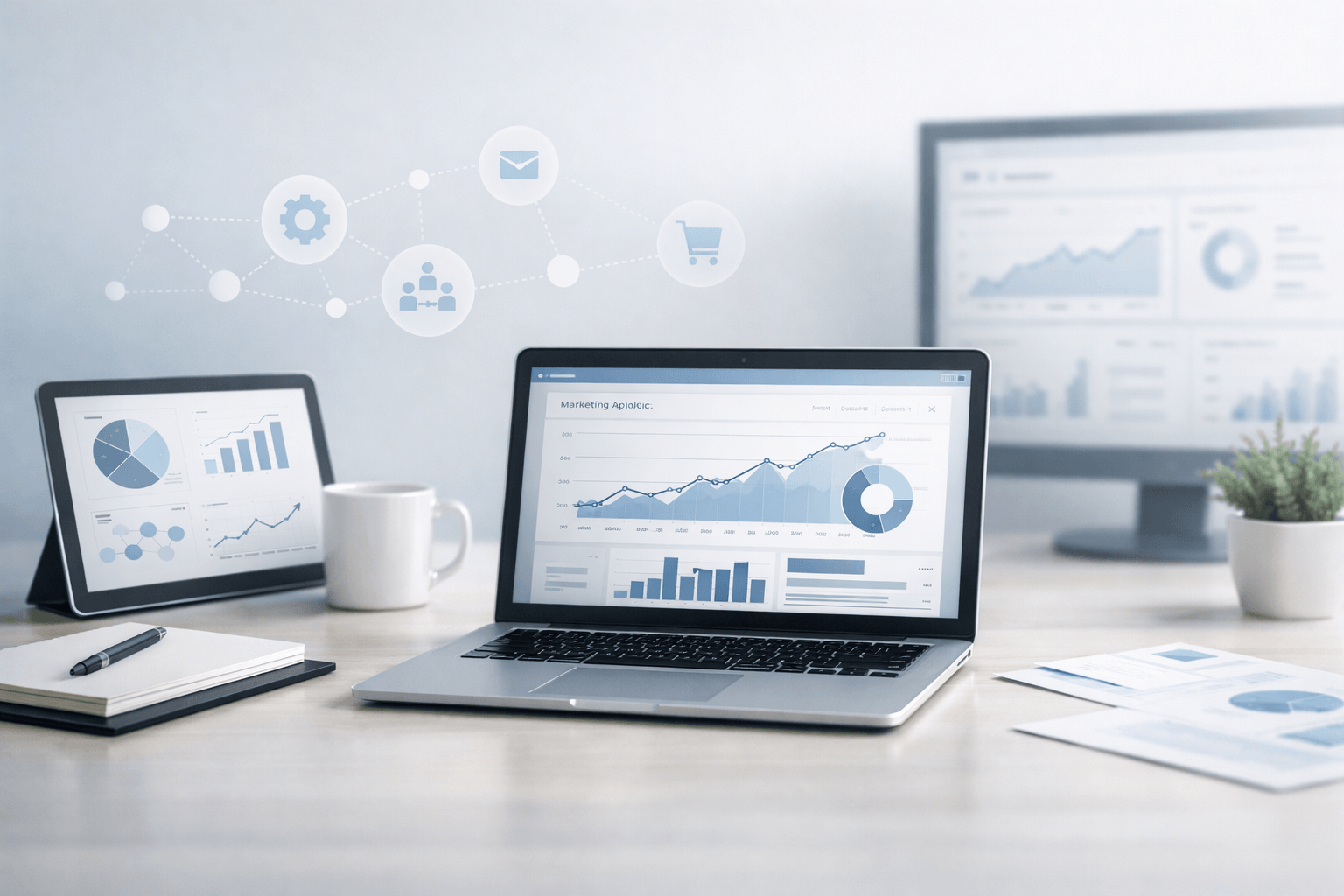
Predictive analytics for audience segmentation represents the third proven application. AI models analyse hundreds of behavioural signals simultaneously to identify high-value customer groups that manual segmentation might miss. This enables brands to target audiences based on actual conversion patterns rather than demographic assumptions. Marketing teams using AI report 50 per cent faster time to market, 45 per cent lower operating costs, and 75 per cent higher job satisfaction. However, proving ROI remains challenging. While 60 per cent report returns of 2–3x or higher, only 41 per cent can demonstrate it through formal measurement frameworks.
Conclusion
AI digital marketing works when you start with clean data and clear objectives, not the other way around. While 88 per cent of marketers use some form of AI, the 6 per cent who have fully implemented it see 30 per cent performance improvements because they addressed data quality and integration first.
Focus your efforts on three proven applications: dynamic creative optimisation, automated budget allocation, and predictive audience segmentation. These deliver measurable returns, provided you maintain human oversight and can demonstrate ROI through proper measurement frameworks.
FAQs
AI will not completely replace digital marketers but will change how they work. Routine tasks like reporting, data analysis, and basic content creation are increasingly automated, while strategy, creativity, relationship building, and cultural understanding still require human expertise and decision-making.
By 2026, AI will be widely integrated into marketing workflows, supporting creative optimisation, automated budget allocation, and predictive audience segmentation. However, only a small percentage of marketers have fully implemented it, and success still depends on quality data, integration, and human oversight.
AI improves marketing campaigns by analysing customer behaviour, engagement data, and conversion patterns in real time. It automatically adjusts targeting, messaging, and budgets to optimise performance, helping businesses achieve stronger lead generation, lower acquisition costs, and higher return on ad spend.
The biggest barriers to AI adoption include poor data quality, weak system integration, and unclear marketing objectives. Many marketers lack control over data strategies and feel unprepared to use AI effectively, while many digital transformation initiatives fail due to misalignment rather than technology limitations.
The most effective AI marketing applications include dynamic creative optimisation, AI-powered budget optimisation, and predictive audience segmentation. These tools automate ad testing, adjust spending based on performance, and identify valuable customer segments, helping marketers improve efficiency and achieve measurable campaign results.