- 31st July, 2026
- By Rob Lawson
Why AI Tools Alone Won't Build a Successful Marketing Strategy
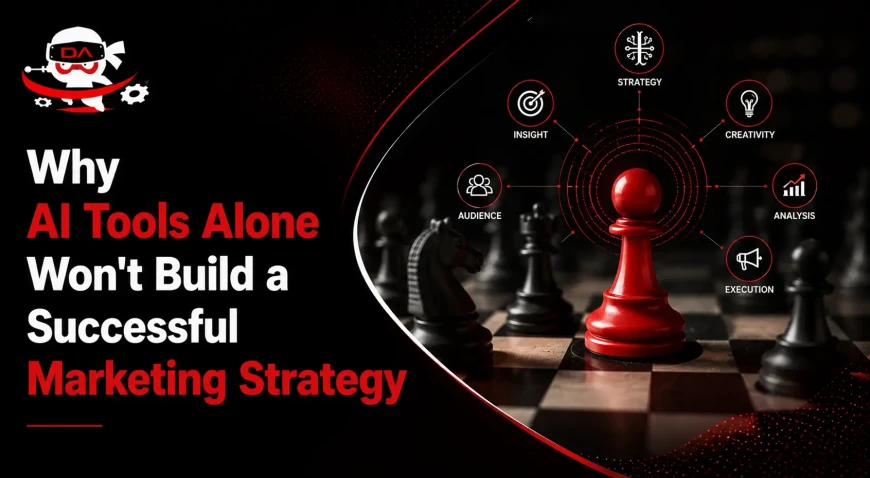
There's a version of this story playing out in small businesses across Australia right now. Someone signs up for a $20 AI tools subscription, starts generating content in minutes, and feels like they've finally cracked marketing. The posts go out. The blogs get written. The carousels get designed. And then, a few months in, they look at the results and realise almost nothing has actually changed. The tool worked. The strategy didn't exist.
With 87% of marketers now using generative AI in some capacity, the technology itself is no longer the differentiator. Everyone has access to the same AI tools for marketing. Everyone can generate a blog post, write an email sequence, or produce a month of social media content in an afternoon. When the playing field flattens that quickly, the thing that separates businesses isn't which tools they're using. It's the thinking behind how they use them. This post is about that gap, why it exists, what it costs, and how to close it.
Why a Strong Marketing Strategy Must Come Before Any AI Tool
Here's an analogy worth sitting with. Give someone a top-of-the-line hammer and no blueprint, and they'll build something. But without a clear plan guiding every decision, what they build will be crooked, unstable, and probably not what they needed in the first place.
AI tools in marketing work the same way. They're extraordinarily capable at execution. They can write, design, schedule, analyse, and automate at a pace no human team could match manually. But execution without direction produces output, not results. A hundred pieces of content published without a coherent digital marketing strategy behind them is just noise with a consistent posting schedule.
Consider a real example. A Melbourne-based retail business started using an AI content tool to publish three blog posts a week and run daily social media content. Output went up immediately. Six months later, website traffic had barely moved and enquiries were flat. When they reviewed the content, every piece was topically reasonable but strategically disconnected. Nothing led anywhere. Nothing addressed the specific concerns of their actual buyers. Nothing was built around a conversion goal. The AI had done exactly what it was asked to do. The problem was nobody had decided what it should actually be working toward.
The businesses that get genuine returns from AI in marketing aren't the ones with the most sophisticated tools. They're the ones who knew what they were trying to achieve before they opened the platform. The tool amplifies the strategy. Without the strategy, it just amplifies the activity.
Key takeaway — AI tools execute well, but without a clear marketing strategy directing them, they produce activity rather than results.
How Leading Businesses Structure AI in Marketing for Measurable Impact
It's worth understanding what the bigger players are doing, not because every business needs to match their spend, but because it illustrates what a strategy-first approach to AI tools actually looks like in practice.
Large enterprises aren't just using AI marketing tools to produce content faster. They're using platforms like Brandwatch to understand consumer sentiment at scale, Sprout Social to monitor real-time brand perception, and tools like Jasper and Copy.ai to maintain consistent brand voice across thousands of touchpoints simultaneously. Some of these platforms cost upwards of $15,000 a month.
The spend itself isn't the point. The point is that every tool in that stack exists to serve a specific strategic function. Consumer intelligence informs campaign direction. Sentiment analysis shapes messaging adjustments. Content tools execute at scale within brand guidelines that human strategists defined. The technology is doing the heavy lifting, but human strategic thinking is doing the steering.
That ratio, AI handling execution and humans handling direction, is what makes the difference. It applies whether you're spending $20 a month or $15,000.
Key takeaway — Enterprise businesses don't succeed with AI because they spend more. They succeed because every tool serves a defined strategic purpose directed by human thinking.
The Strategic Limitations of AI Tools Every Business Should Understand
Let's be direct about where AI tools in marketing hit their ceiling, because understanding the limits is what allows you to use them well. AI handles execution confidently. But there's a clear boundary between what it does well and what it simply cannot do. Here's where that line sits:
AI can write a blog post, but it can't tell you which topic will resonate most with your specific audience at this particular moment in their relationship with your brand.
AI can generate ad copy variations, but it can't determine which message addresses the real objection standing between your prospect and a decision.
AI can schedule content across platforms, but it can't read the nuanced dynamics of your market and identify the positioning that would make your business genuinely stand out.
Marketing automation handles the repetitive, the scalable, and the consistent exceptionally well, but it can't answer why a campaign is underperforming or what needs to change.
The questions that actually determine marketing effectiveness, who are we talking to, what do they need to hear, where are they in the decision process, and why should they choose us over the alternative, these require human judgment informed by real business understanding. No prompt solves that.
Businesses that lean entirely on generative AI for their marketing strategy end up producing campaigns that look and sound like everyone else's. They're drawing from the same training data, using the same prompts, and applying no differentiated thinking to guide the output. The result blends into the noise rather than cutting through it.
Key takeaway — Generative AI handles execution well, but the strategic questions that actually drive marketing results still require human judgment and genuine business understanding.
Where Human Strategy and AI Tools Work Best Together
The most effective marketing setups right now aren't choosing between human expertise and AI capability. They're combining both deliberately, with each doing what it does best.
Here's what that looks like in practice:
Human strategists define the audience, the positioning, the message hierarchy, and the campaign objectives before a single prompt gets written. From there, marketing automation becomes the engine that scales those decisions consistently across every customer touchpoint, without losing the strategic intent behind them.
AI marketing tools execute against that framework, producing content variations, testing copy, scheduling distribution, and scaling output.
Human judgment reviews, refines, and redirects based on what's actually working in the market.
Strategic thinking continues to evolve the approach as the market, the audience, and the business change.
Neither side of that equation works without the other. AI without strategy produces generic output at speed. Strategy without AI execution struggles to compete on volume and efficiency. The combination, done intentionally, is where genuine competitive advantage lives.
Key takeaway — The most effective digital marketing strategy right now uses AI for execution and human expertise for direction, with neither replacing the other.
How Specialist Strategic Guidance Maximises Your AI Marketing Investment
One of the most common mistakes businesses make when building their AI-assisted marketing is trying to figure out the strategy side alone. The tools are intuitive enough that it feels like everything should be manageable internally, and the execution side often is. The strategy side is where specialist knowledge makes a disproportionate difference.
Understanding how to structure a website that converts, how to design a campaign that moves people through a decision journey, how to position a business in a crowded market, and how to use AI tools for marketing within a coherent digital marketing strategy rather than alongside one, these are skills that take time and experience to develop. Working with people who have already built that knowledge means not having to learn through months of underperforming campaigns.
The businesses seeing the strongest results from AI in marketing right now are almost always the ones that have combined capable tools with experienced strategic guidance. The tools provide the scale. The expertise provides the direction. Together, they produce marketing that doesn't just get published but actually converts.
Key takeaway — Bringing in experienced strategic guidance alongside AI tools shortens the time between starting and seeing real results, because it removes the trial-and-error cost of figuring out strategy alone.
Positioning AI Tools as Execution Engines
AI tools are genuinely remarkable. Generative AI has changed what's possible for businesses of every size, and that change is real and significant. But a tool that amplifies your thinking can only be as good as the thinking it's amplifying.
If the strategy is clear, specific, and grounded in a real understanding of your audience and your market, AI will help you execute it faster, more consistently, and at a greater scale than you could manage manually. If the strategy is vague, generic, or absent, AI will help you produce vague, generic content faster. Technology doesn't fix thinking. It accelerates whatever thinking is already there.
Before deciding which AI tools to use, these are the questions worth answering first:
- What are you actually trying to achieve? Without a defined goal, whether that's leads, conversions, brand awareness, or retention, AI has no meaningful direction to execute toward.
- Who exactly are you trying to reach? A clearly defined audience profile shapes every content decision. Without it, AI defaults to generic messaging that speaks to no one in particular.
- What does your audience need to hear at each stage of their decision? AI can produce content at every stage of the funnel, but only if a human has mapped out what those stages look like for your specific buyer.
- What makes your business the right choice over the alternative? AI can communicate your positioning, but it can't define it. That requires genuine understanding of your market, your competitors, and your own strengths.
Answer those questions clearly and your digital marketing strategy becomes something AI can actually serve rather than something it quietly undermines by producing polished but purposeless content.
Key takeaway — AI amplifies the thinking behind your marketing strategy. If the thinking is strong, AI makes it more powerful. If it's weak, AI just makes the weakness more visible, faster.
Ready to Build a Strategy Your AI Tools Can Actually Serve?
If you're ready to build a marketing strategy that uses AI tools properly rather than just prolifically, the team at Digital Assassin can help. They work with businesses to develop digital marketing strategies where human expertise and AI capability work together the way they're supposed to. Book a Discovery Call and find out what that looks like for your business.
Book a Discovery CallFrequently Asked Questions
AI tools are excellent for generating content, automating workflows, and analysing data, but they cannot define business goals, audience positioning, or competitive strategy. A successful marketing strategy requires human expertise to guide how AI tools are used so every campaign supports measurable business outcomes.
The most effective approach is to use AI in marketing as an execution tool rather than a replacement for strategic thinking. Businesses should first define their target audience, objectives, messaging, and digital marketing strategy before using AI marketing tools to create, optimise, and distribute content at scale.
Generative AI can produce blogs, social posts, emails, and advertisements quickly, but it cannot fully understand customer motivations, market trends, brand positioning, or long-term business objectives. Human oversight ensures AI-generated content aligns with business strategy and delivers meaningful results.
The best AI marketing tools depend on your goals. Businesses commonly use AI for content creation, marketing automation, customer insights, SEO, and campaign optimisation. However, even the most advanced tools perform best when they're part of a well-defined marketing strategy rather than being used independently.
No. AI can improve efficiency and automate many marketing tasks, but it cannot replace the strategic planning needed to attract, engage, and convert customers. A strong digital marketing strategy provides the direction, while AI tools help execute that strategy more efficiently and consistently.